The New Carbon Category Imperative
As the global carbon market closes out 2025, the central theme is an unwavering commitment to integrity and permanence. The market is demanding a new class of credit that delivers genuine, measurable removal, rather than simply avoidance. This definitive shift is driving massive interest and investment into durable Carbon Dioxide Removal (CDR) technologies.
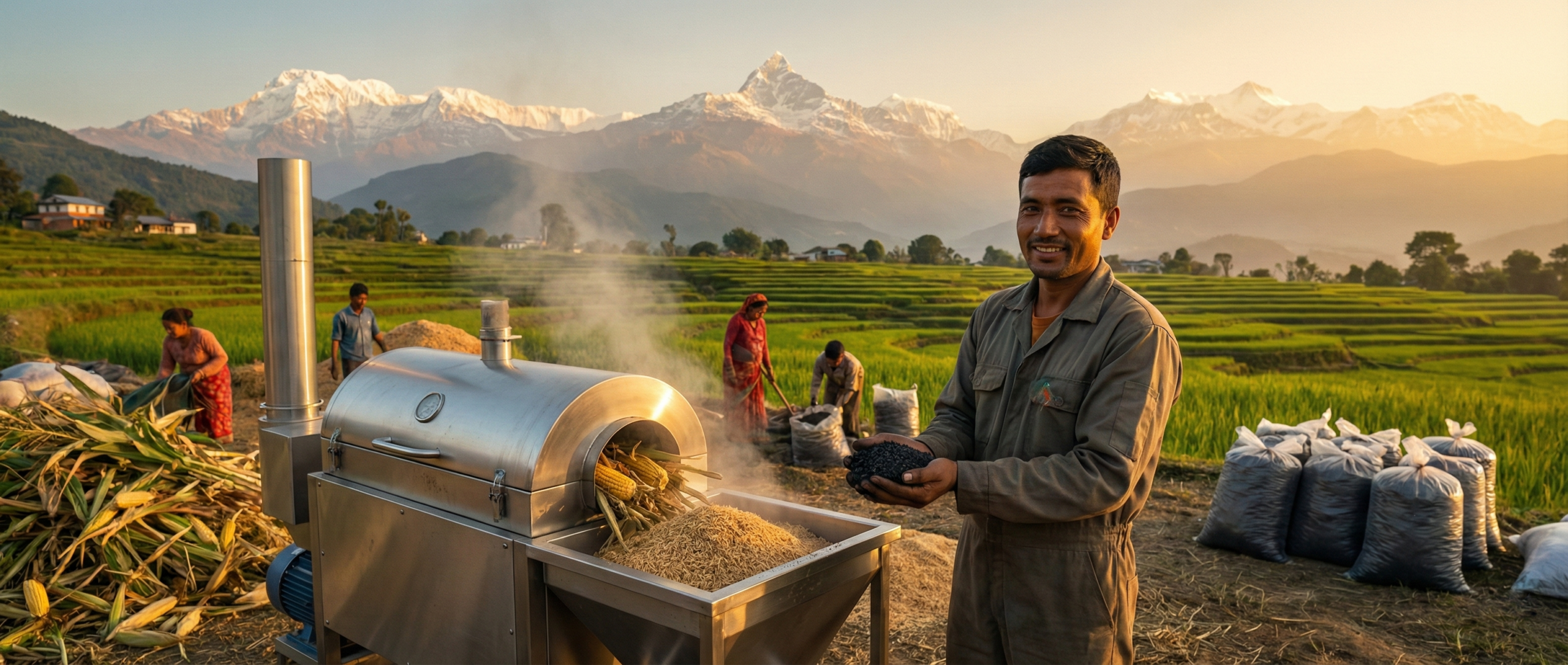
For the entire South Asian region, this focus creates a significant opportunity: the specialized, high-impact asset known as Biochar Carbon Removal Nepal.
This final post of the year analyzes the critical new standards and shows how a CDR solution rooted in sustainable agriculture is transforming Nepal’s climate mitigation landscape into a highly bankable investment.
The ICVCM Standard and the Permanence Premium
The Integrity Council for the Voluntary Carbon Market (ICVCM) has solidified its role in 2025, confirming that only the most robust credits will receive market validation and premium pricing.
CCP Label Dominance
Credits bearing the Core Carbon Principles (CCPs) label are the most in-demand credits, commanding a price premium of up to 25%. Verra has begun issuing the first CCP-tagged credits under improved methodologies, signaling that compliance is now table stakes.
Shift to Removals
Analysts confirm the market is moving decisively toward Carbon Removal (CDR) methods—such as Direct Air Capture (DAC) and biochar—which are essential for reaching Net-Zero goals.
The Durability Mandate
The ICVCM stresses the importance of long-term permanence. Unlike some avoidance projects, Biochar Carbon Removal (BCR) offers exceptional durability, capable of storing carbon for 100 to 1,000+ years. This permanence is what premium buyers require.
The New Asset Class: Biochar Carbon Removal
Biochar is rapidly becoming the mainstream mechanism for durable CDR, primarily because it offers a “triple-stack” of benefits that de-risks the project for global investors.
Market Growth
The Biochar Carbon Removal (BCR) market has seen exponential growth, with volumes contracted experiencing a 131.6% Compound Annual Growth Rate (CAGR) between 2022 and mid-2025. Biochar currently represents more than 90% of global CDR deliveries.
Triple Revenue Stream
Unlike traditional avoidance projects (single revenue stream), biochar creates multiple value cascades that reduce project risk and ensure viability:

- Carbon Credits: Revenue from premium, high-permanence credits.
- Agricultural Yields: Revenue from enhanced crop productivity and reduced fertilizer costs.
- Waste/Energy: Revenue from converting agricultural waste (eliminating open burning) and utilizing bio-oil/syngas.
- Article 6 Potential: Biochar’s high durability, measurability, and certification under standards like Verra and Puro.earth make it a prime candidate for future participation in bilateral Article 6.2 compliance transactions.
Biochar Carbon Removal Nepal (BCR) Solves the Farm Crisis
The application of biochar is uniquely suited to solve one of Nepal’s most chronic development challenges: poor soil health and low agricultural productivity. This convergence of climate and development benefits makes Biochar Carbon Removal Nepal projects highly attractive to impact investors.
Solving the Yield Deficit
Field trials across Nepal have shown that applying nutrient-enriched biochar can significantly boost farm outputs:
- Productivity Gains: Biochar application improves soil chemistry and nutrient availability, increasing crop yields by an average of 15% to over 100% across various trials, depending on the crop. For maize biomass, increases of 108% were reported.
- Soil Health: It improves soil physical properties, retains water and nutrients, and helps treat Nepal’s naturally acidic soils, sustaining production and reducing reliance on imported, carbon-intensive chemical fertilizers.
- Economic Value: This stacking effect means that the total economic value of a project can exceed $1,000 per hectare annually from both carbon revenue and agricultural benefits, providing financial resilience for smallholder farmers.
The Triple-Stack Integrator
The market shift to durable CDR and high-integrity CCP standards is the single biggest opportunity for climate finance in Nepal’s agricultural sector. This requires expertise in converting biomass waste via pyrolysis technology, certifying the resulting biochar to the highest global standard, and ensuring seamless integration into the local farming supply chain.
Our firm specializes in developing these triple-stack revenue models. We combine the technical pyrolysis process with certification under the world’s strictest standards to ensure permanence and financial viability.
Permanence is the new currency of the carbon market. Green Eco Solution is pioneering Biochar Carbon Removal Nepal by integrating advanced CDR technology with essential agricultural uplift. We offer investors the guarantee of 1000-year carbon storage combined with a robust, triple-revenue model that transforms farm waste into verified climate impact.
Conclusion
The transition to high-permanence CDR is irreversible. Nepal, with its abundant agricultural residues and urgent need for soil improvement, is an ideal incubator for scalable Biochar Carbon Removal Nepal projects.
As we look toward 2026, the mandate is clear: invest in assets that solve multiple problems simultaneously. Partner with Green Eco Solution to secure high-integrity, triple-stack biochar credits and lead the way in sustainable CDR investment.
Sources
- Integrity Council for the Voluntary Carbon Market (ICVCM). High-Integrity Carbon Markets at New York Climate Week 2025.
- CDR.fyi. Biochar Carbon Removal Market Snapshot
- Agrospectrum Asia. From soil to carbon credits: Why Biochar could be Global South’s climate advantage.
- ResearchGate. (PDF) Biochar for Improving crop Production in Nepal
- CABI Digital Library. PROSPECTS OF BIOCHAR AS SOIL AMENDMENT IN NEPAL HILL FARMING SYSTEMS.
- Carbon Pulse. Over 90% of 2025 biochar carbon removal credits already sold, finds analysis.
- ICIMOD. Roadmap for biochar carbon removal in Nepal: Cross-learning from feasibility assessment in India and Nepal.
- CarbonCredits.com. Carbon Credit Market Gains Integrity With ICVCM’s Approval of 6 New Removal Standards.